
97% of Enterprise Transformations Fail - Increase Your Odds By Avoiding This Famous Cost-Cutting Mistake

Enterprise Transformations have a dismal track-record of success
At any given point, a full 90% of enterprises are pursuing some form of “Transformation.” And yet, despite 50 years of focused study by management consultants and MBA professors alike, Transformations fail at dismally high rates:
In our own survey of the research, only 3% of enterprises can cut costs for 2 years running and still hit revenue targets
Clayton Christensen frequently cited research where, after a period of faltering growth, only 6% of companies will ever return to competitive growth rates
Top-tier consulting firm Bain estimates that only 8% of companies ever hit the desired outcomes from a digital transformation
If anything, these stats understate the difficulty of transformation. Deep down, we expect a "transformation" to result in some kind of, you know, transformation. That is, we expect a set of interventions that set an organization on a new trajectory in terms of profitability, competitiveness, and growth. By this definition, it's obvious we're falling short. For example, we've never heard of a Kodak transforming its way to Google.
Old-school cost-cutting methods are a major reason Transformations fail
Cost-cutting is not always an explicit aim in Transformation. Across two decades, we have led many kinds of Transformation with a variety of aims. We have worked on Digital Transformations, Culture Transformations, and numerous Lean/Agile efforts. Sometimes the stated focus is on innovation, other times it’s about improved risk outcomes.
Whatever the starting aim of these efforts, however, cost-cutting always became a major focus eventually. Sometimes this is due to a shift in the market and other times it was expected all along. Whatever the reason, increased focus on cost always creates some level of heartburn for Transformation Professionals.
At first blush, you might think cost is to “unsexy” for Transformation leaders with all of our newfangled methods. It’s a fair observation that most of us have been guilty of chasing the occasional trend (raise your hand if you’re currently running a “Spotify model” in your org).
This probably misdiagnoses our real motivation, however. All the Transformation Professionals we know care, first and foremost, about one thing: making an impact on their org with the best tool for the job. To this day many Transformation leaders are only too happy to deploy some lean technique from 40 years ago if they think it will help.
That’s where the real problem with cost reduction comes in: the “best” tools for cost-cutting haven’t evolved much and never seemed to work that well.
Cost-cutting methods have not evolved much

Transformation leaders are generally among the most knowledgeable when it comes to business. Maybe they started as a McKinsey director after their dual JD + MBA. Maybe they sold three startups to Jeff Bezos before the age of 25. Maybe they once ran all of product for Procter & Gamble, Facebook, and Spotify... simultaneously. Whatever their path to transformation, most Transformation Professionals have a broad set of experiences to draw from.
And yet, despite the vast array of tools at our disposal, we all still resort to the same, familiar cost-cutting patterns:
The X% haircut: "All divisions have to find 10% cost reduction"
Spans-and-layers: "Fire anything beyond 7 direct-reports and 5 layers deep"
Benchmarking: "Reduce cost until we match top quartile banks in APAC"
Bottom-up initiatives: "Crowdsource ideas and bank saves until we hit target"
Let's be real. We at Enthoosa have triggered all these patterns at some point in our career. How could you not, with all the pressures we face? You’re 6 months into the Transformation and you’re still waiting for benefits to show up in the P&L. The CEO is starting to get impatient and suggests cost-reduction is just what’s needed. You’re only too happy to oblige thinking that, if you control the cost program, you can at least protect the rest of your fledgling Transformation from deletion. Thus, in order to live to Transform another day, you trot out one of these cost-cutting sledge-hammers and go to work!
Now, deep down, most executives (except CFOs) wrestle with doubts about these approaches to cost-cutting. Are we cutting fat or muscle? Is that role truly "waste" or is it the lynchpin to this year's entire revenue target? Are any of these cuts going to stick or is it all going to “grow back”?
Over time, we've gotten used to this uncertainty. Research suggests most executives create a certain logic for handling this uncertainty. It turns out most executives believe only 20% of enterprise spend has any real impact on value generation. The other 80% of activity is, by implication, somewhat discretionary.
That finding might explain our comfort with the famous 10% haircut. If 80% of cuts land on discretionary activity, it might offset any damage we inadvertently do to value creation. Surely, we can always fix revenue issues later, right?
Without the right information, these approaches destroy more revenue than they save

It’s worth unpacking the 10% haircut approach in more detail so we can interrogate it. Our intuition seems to apply the following logic:
The ratio of discretionary activity to value-generating activity is 4:1
With a 10% haircut, we will apply cuts to all areas equally
Our cut should generate 4x more value from good cuts than we lose in 1x of bad cuts
Therefore, while the 1x in bad cuts is regrettable, we’re still ahead
Yes, yes we can see the tiny flaws in the logic. But we’re in a rush and we can take comfort in this: every other company is following the exact same approach! And they’re all doing ok, right!
Unfortunately, almost every step of the logic above is wrong. For instance, most companies are not doing ok with these approaches (remember the 97% failure rate for Transformation). Similarly, by most analyses, far more than 20% of a given org is working on value-generating activity (if it wasn’t, that’s a bigger scandal than a 10% cost cut). While these points aren’t major, they should have been obvious enough to scare us away from haircuts.
The bigger issue, however, is more subtle: on average, whenever you cut a revenue-generating activity, you lose 50x more in revenue than you save in cost.
We showcased this effect in a recent newsletter (“Boost Revenue 10% and Get Promoted”). A client had unknowingly sacrificed $68M in annual revenue for a mere $1.4M in cost reduction elsewhere in the organization. They had fallen for a version of the logic above and made cuts that added 80 days to client onboarding time. That was 80 days of revenue, for each client, gone.
And this wasn’t an isolated example. One company averaged 9 months when onboarding digital partners, costing itself $56M in annual revenue. Still another client required 6 months to reach "go-live" with its institutional clients, driving a loss of $40M in annual revenue.
The excessive onboarding time, in all of these cases, was a direct result of cuts elsewhere in their organization. In each case the cuts had a negative ROI over -50x.
What’s worse, all of these losses could have been avoided if the Transformation leaders had better information.
Today’s tools obscure the link between cost & revenue

Most executives are flying blind when they cut costs. It's not for lack of tools—they have plenty. The problem is these tools are designed to track the wrong metrics.
Enterprise software for tracking performance typically measures:
Budget variance by cost center
Headcount by department
Utilization rates for resources
Project completion dates
Process cycle time
What's missing? None of these tools directly connect back-office activities to revenue generation and speed. When an executive cuts three positions from the procurement team, no dashboard lights up to show the impact on revenue in the digital team. The digital team will wake up next quarter having sold the same # of services for the same price, wondering how revenue could drop 10%. It’s because, after you closed, it took X days longer to get on your platform and start paying.
It's like trying to do surgery with a blindfold on. Even the most skilled surgeon will make catastrophic cuts if they can't see where the vital organs are.
Cut costs safely with tools tailored for Transformation

There is an easy way to identify cost opportunities without sacrificing revenue. The approach applies to any activity that is countable, no matter the level of variety. It works for audits, legal contracts, strategy packs, sales processes, and more. Best of all, these approaches are tailor-made for Transformation Professionals.
Just start counting and cut anywhere that’s not constrained
One fast, and safe, way to cut cost is to find areas that have more capacity than necessary. The way to do that is as follows:
Count inflow (how many items enter the process per month)
Count outflow (how many items complete per month)
Count current backlog (how many items are in progress)
Calculate the average latency (backlog ÷ outflow rate)
If the outflow is the same or higher than the inflow, the process is functioning better than most. If the function has a small backlog and fast completion time, you can start cutting or redeploying resources. Specifically, you can cut as much as you want until the average outflow is higher than inflow plus about 10%. If you go too far, you have to add resources back or you're likely to destroy value.
For a deeper dive into this counting approach, see our article “Boost Revenues 10% and Get Promoted With Amazon's Trick for Faster Client Onboarding” where we show how one financial institution used this method to identify $68M revenue opportunity.
Cut areas that don’t show a direct connection to delivery
The second approach to cutting is also fast, but it is harder politically, as it goes against certain unspoken "norms" we've all gotten used to with transformation.
Even with an org-wide rollout of capability, the main targets are usually the same: IT, operations, and, occasionally, the salesforce. What's odd about this? These are the only groups directly delivering value to customers in the form of sales, client onboarding, new features, and support. These are the very groups, in other words, most likely to affect revenue.
In light of this, where should we actually focus our efficiency efforts? Ironically, in all the places we typically avoid. Transformations tend to focus on delivery because that’s where the data is. That "strategic HR" initiative, in contrast? It might be valuable. But without clear links to delivery, it’s hard to judge.
In one organization, we showed HR had a 6-month hiring backlog, due too under-capacity in recruiting. Meanwhile, they dedicated half their team to a large culture initiative on "delivery excellence." What had triggered the need for delivery excellence? Slow delivery times. What was a main cause of long delivery times? The hiring backlog.
I genuinely believe in the importance of functions like HR, Finance, Risk, and Strategy. Yet, in our experience, leaders avoid these groups out of an almost superstitious concern over lost value. Notice the paradox? If an area is delivery-focused, but just a small step removed from revenue, we interrogate it constantly. If, however, an area is completely disconnected from both delivery and revenue altogether, we don’t touch it.
If you have to start making “sledge hammer” cuts, you should reverse the logic. Start with the teams furthest away from delivery. The cost of a mistake will be much lower.
Better still, get the information you need to avoid bad cost cutting altogether.
Use the right tools for the job
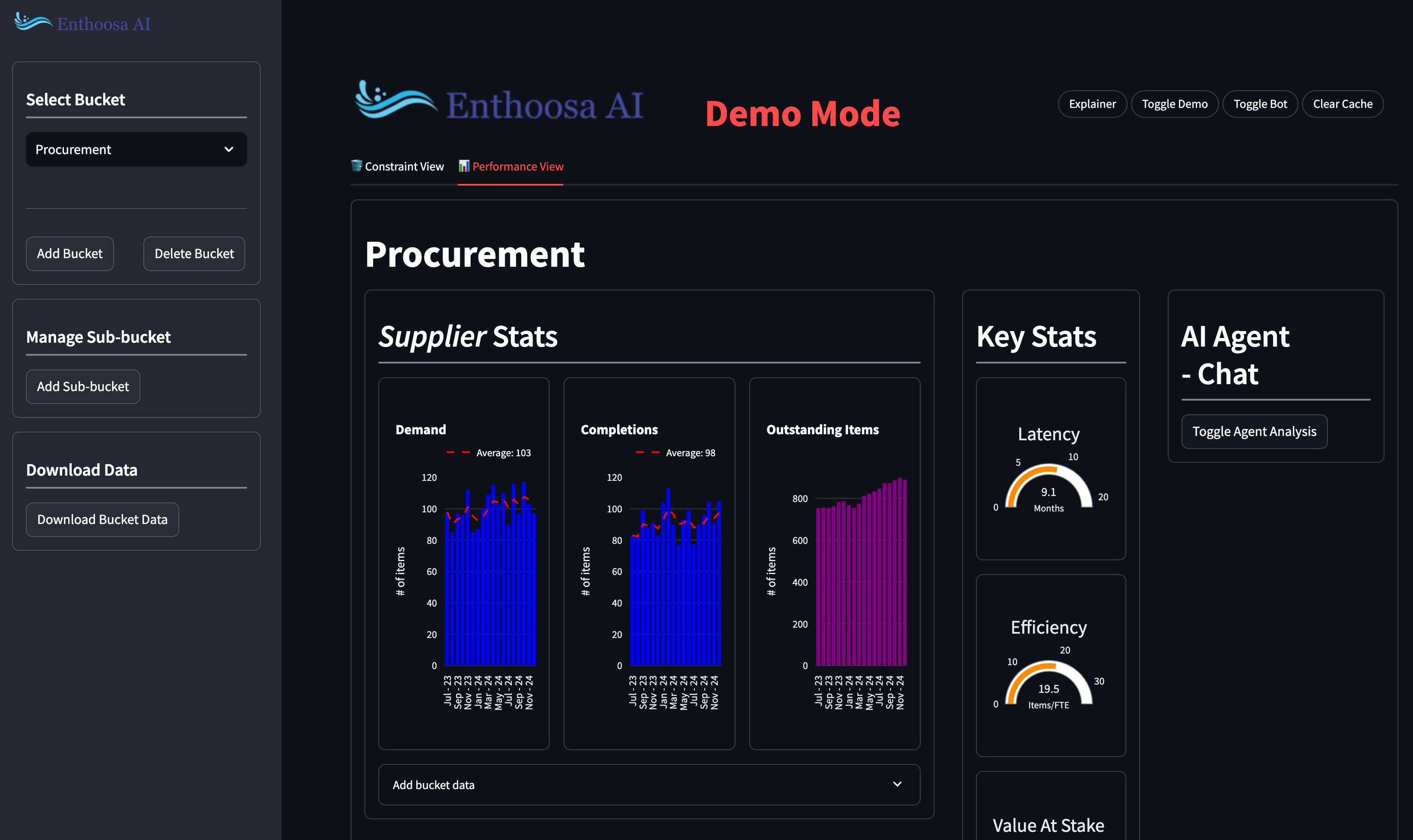
For the record, we understand all the confused approaches people follow around cost. It's not actually possible to make an informed decision without, you know, information.
The traditional solution to this problem is even worse than the problem itself. A typical consultant will launch a six-month process-mapping exercise, documenting every step, handoff, and decision point across the organization.
By the time this exercise completes the information is already worthless:
The processes have changed
The market has moved
The cost-cutting is done
Revenue generation is damaged
In one global client, we spent months preparing our transformation rollout, making all sorts of pretty maps and process diagrams. All at once COVID hit and none of it mattered. The context will inevitably shift and your data won’t keep up.
It's why Transformation Professionals need better tools—ones that provide clarity and confidence—at a pace that actually works for transformation.
At Enthoosa, our aim is to empower Transformation Professionals and help them make the difference they always strived for. We help you find and capture sustainable sources of value quickly, with confidence. Our software differs from everything else out there. We help you:
Pinpoint capacity-constraints in mere hours, not quarters
Identify immediate improvements that improve cost and revenue
Validate if an area is safe to cut
Calculate the exact ROI of a fix so you can prove your value to the org
The best part? You can start right now. Our software works instantly, without download, from our website. All your data lives and runs on your computer: we never see it or touch it. You can subscribe to our tool like you would an online newspaper; all you need is a corporate card. If you ever have trouble you can call us for support or cancel for a full refund.
Better still, you can do this all by yourself. We don’t need to wire in data feeds or map a bunch of processes. In five minutes, with basic information you already have on hand, you’ll find constraints. After a few phone calls, you will identify your first $20M in benefits. After a few weeks you’ll bank CFO-verifiable savings.
Find value. Make an impact. Get promoted!